






Price: [price_with_discount]
(as of [price_update_date] – Details)
[ad_1]
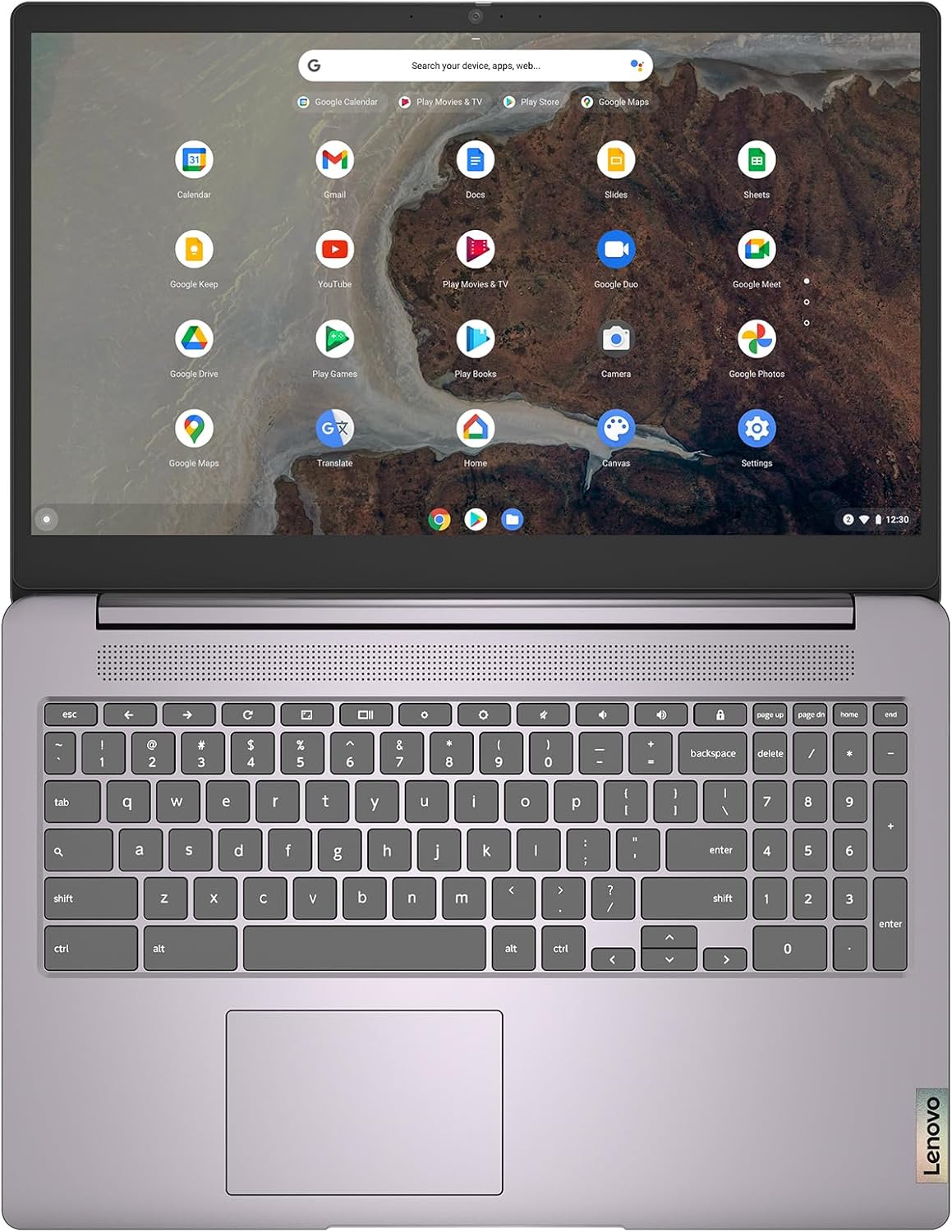
Get this user-friendly Chromebook for its big screen and high performance at great value. With Intel Inside, the IdeaPad 3 Chromebook 15″ loads content-rich webpages quickly, provides brilliant video playback, and lets you multitask effortlessly while delivering up to 10 hours of battery life. Control your smart devices or manage your day with Google Assistant on Chromebook. It’s 15″ portable thin and light casing integrates an easy-to-flip lid, privacy shutter and large trackpad.
Power and performance – the Intel Pentium N6000 processor and 8 GB of LPDDR4 memory. Get things done with even more speed and responsiveness with up to 128 GB eMMC storage on the streamlined Chrome OS.
Made for ease of use – Watch shows with fewer distractions on a 15″ FHD IPS display with narrow bezels for more screen real estate and wider viewing angles.
Audio – Stream audio that’s remarkably loud and clear from IdeaPad 3 Chromebook’s user-facing stereo speakers, while its privacy shutter gives you security after video calls.
Stay connected – wherever you go with fast, reliable Wi-Fi 6 for smooth streaming and browsing. These include two USB Type-C ports, one USB 3.0 port and one HDMI port, as well as one microSD card reader and one Audio combo jack
Chromebook OS – Running on the lightning-fast Chrome OS, it boots up in seconds, updates automatically, and is protected by built-in virus protection.
Customers say
Customers find this Chromebook to be an excellent value for money, performing well for their needs and being easy to use and set up. The laptop is super fast, boots up quickly, and has good battery life that charges in short order. They particularly appreciate its suitability for studying and coursework. The screen quality receives mixed reviews, with some praising the FHD clear display while others find it poor.
[ad_2]
6 reviews for Lenovo IdeaPad 3 Chromebook Laptop | 15.6 inch Full HD Laptop | Intel Pentium Silver N6000 | 8GB RAM | 128GB eMMC| Chrome OS| Arctic Grey
Add a review



What an improvement in ChromeOS hardware and software!
After about seven years since I last used ChromeOS, I decided to have another go as my existing desktop machine was getting old and I was becoming tired of its high power usage, its quirks and, really, the need to be a system manager.That turned out to be an excellent idea as ChromeOS has come on by miles since then in both hardware and software. I went for this particular Chromebook as it was discounted by £60 and has had consistently good reviews, which turned out to be justified.First, Lenovo’s hardware. It is a “Chromebook Plus”, a new Google initiative which, in practice, means a 12th-generation Intel CPU or newer, sufficient memory, a large SSD rather than the slow eMMC storage often used on Chromebooks, and a HD screen. Chromebook Plus is a good idea as Chromebooks have modest hardware requirements but, in the past, those led to over-enthusiastic cost-cutting and damaged the brand.This Chromebook has 8GB RAM, a 256GB SSD and a 1920×1080 screen (non-touch) which is good – bright with small bezels at the side and slightly bigger ones top and bottom. It also has an N305 processor, which is 13th generation Intel so effectively current (14th generation processors were notionally released in January 2024 but machines based on them started becoming available in April) and, as it turns out, more than sufficient. (It is described as an “i3” but I would put it as a bit below that, not that I have found any performance issues). There is a fan, but it is rarely on. In fact, nothing gets hot in my experience.The case is two-tone metal on the top, plastic on the bottom and astonishingly robust, even stronger than my work laptop which cost about five times as much. There is not the slightest give. Even the screen hinges are solid.The keyboard is excellent – large keys (a benefit of ChromeOS, which removes redundant keys) with white backlighting, bright and evenly lit and a little light leakage on the top row only. The keys have a distinct action and feel good; I was able to put aside my mechanical keyboard, which is rare as I normally have to use it because laptop keyboards tend to feel dead. I use a mouse rather than a touchpad, so cannot comment on the second.The camera is 1080p = 1920×1080 resolution (another Chromebook Plus stipulation and unusual – even on high-end laptops the resolution still tends to be 720p = 1280×720) and gives an image which is bright and without much noise even in poor light. There is a tiny privacy slider built into the case but, unfortunately, no LED to show that the camera is on.The sound and microphone quality are good. In fact, I forgot to switch to my HDMI monitor’s speakers and didn’t notice for some time because the built-in sound is loud.There is one USB-C port, two USB-A ports, a HDMI port and a headphone socket. The USB-C port is used for power so, if you want a free USB-C port, you will either have to keep switching cables or buy a USB-C hub. Some reviews are negative about this, but I prefer USB-A and HDMI because it is going to be a long time before everything uses USB-C and an external hub gives far more ports than a laptop ever could. The USB-A ports are stiff, but that will ease over time.The only real hardware weakness is the power adapter which is a brick, albeit a relatively small and light one. I replaced it with a 65W Anker adapter and matching USB-C cable, which is much less obtrusive.The Chromebook charges in short order – full charging takes roughly two hours to go from 50% to 100% using the Anker adapter – and the battery life is huge – I would say well over a working day, say 11-13 hours. There is a LED next to the USB-C port which is orange when charging and green when charged. A recent borrow from Android is adaptive charging, which is less hard on the battery than always charging at full tilt to 100%.As hinted earlier handling of my second monitor (Dell 2K) is perfect – ChromeOS always knows when it is plugged and when it is not, and there is no nonsense like the configuration suddenly being forgotten.ChromeOS? There is no question that it is a full operating system now and “get a proper computer” is outdated. It does everything I would expect. It is really three operating systems in one:ChromeOSAndroidLinux(Windows is in effect out of scope as installing it is a bad idea – the Chromebook must be put in developer mode via a number of hidden keypresses, which is inadvisable anyway as it weakens system protection, then there is a risky series of steps to replace the firmware which involve opening the case, temporarily removing an internal battery, and running a script from the Linux terminal).It is perfectly viable only to use ChromeOS facilities, but the others add a lot.ChromeOS provides the basic desktop, windows, Launcher, Shelf (task bar), System Tray with menu and applications (Chrome Apps), starting with Chrome itself and including a file manager, a text editor, a terminal and various others. The user interface animations are well done – attractive without being flashy or excessive. There are all the configuration options one would expect and some unusual ones including a full keyboard remapper. It is surprising how keyboard-centric ChromeOS has become: there is a very useful Key Shortcuts application which gives all the possible key presses and combinations – and there are dozens. It has some excellent implementations of standard features such as Desks (multiple desktops) and Overview, which has a dedicated key on the top row. Another dedicated key makes the current window full screen, and the Caps Lock key has been replaced by an Everything key (as Google calls it) which opens the Launcher and has a number of other functions when escaped. There is no dedicated search key; press Everything and start typing into the field at the top of the Launcher (“Search your images, files, apps and more”).Android is integrated – Google Play is present and can be used to install apps which appear as icons in the Launcher. The only problem I have seen is that most Android apps solely support a phone screen size; some support tablet size and a very few have a free choice of screen size. Unfortunately, the chosen size is not remembered on reboot and reverts to phone. As it turns out, Adobe Reader supports full screen and is a much better PDF reader than Gallery, the inbuilt app, which has bugs.(As there is not long to go, it is worth noting that Chrome Apps will be phased out in January 2025, so after that it’ll be Android or Linux applications only plus Progressive Web Apps – in other words, Web sites which offer an option to be installed and may be run from the Launcher or the Shelf via an icon).Linux is supported by a container which is not installed by default so must be downloaded and installed, taking 10GB of space by default or more if chosen. It provides a Debian 12 environment with security updates coming from Debian, not (thankfully) some Google take on them. Again, Linux applications appear in the Launcher. A quirk is that sudo is required where one would expect in desktop Linux but there is no super user password.Frankly, Linux support is not as good as that for Android in ChromeOS and has some issues:- The whole subsystem occasionally crashes, although it does come back after a few minutes.- Graphical applications are hard to get working because Debian uses Wayland and the implementation is shaky. That said, Firefox works straight off. By default it is the relatively obscure ESR version (intended for corporate use as it remains unchanged for several months rather than four weeks, only receiving security fixes in that period), an eccentricity of Debian, but Mozilla has recently implemented a repository supporting the release, beta and nightly versions which can be set up with a few commands.- I could not get flatpaks to work. Despite appearances flatpaks are technically complex to implement and there are masses of tweaks and configurations online to try to get them running; I decided to skip those and install everything the old-fashioned way using .deb files.- Applications can only see files written by Linux; those written by ChromeOS or Android must be copied into the Linux folder tree. (ChromeOS and Android can see each other’s files, and Linux files).- Applications don’t follow the ChromeOS theme so have to be switched manually between light and dark.- Some applications (e.g. Firefox ESR but not standard Firefox) appear slightly fuzzy.The (ChromeOS) file manager has to cope with three operating systems plus Google Drive (four different home folders!) and does it well – it is clear which operating system’s files you are accessing and just about anything can be cut and pasted between anywhere; for example, a URL in the Firefox (Linux) address bar can be cut and pasted into the Chrome address bar.One niche, but surprising, integration is that, if you set up an Android VPN app, the VPN is shared with ChromeOS and Linux. That was about a hundred times easier than the three different configurations I was expecting.One of the best things about ChromeOS is updates. To simplify, ChromeOS is split into two instances. An update is not a patch; it is a full instance of ChromeOS which the Chromebook reboots from after downloading. If it works, the first instance is deleted; if it fails, the second instance is deleted and the first instance is rebooted from. The configuration and user files are separate and linked to the current instance. This “A-B update” is so much better than Windows’ method of inserting patches into a single, increasingly put-upon instance with the configuration and user files mixed up in it.I switched to the beta version of ChromeOS out of interest. It is solid and entirely suitable for day-to-day use but unfortunately, like most vendors, Google is bad at writing change logs so it is hard to work out the changes in the latest beta. At least it is clear what version the machine is running, as there is a “bug” icon in the System Tray and “Beta” followed by the version number is permanently displayed in the System Tray menu. Beta is updated roughly every week; it is possible to move to more frequent builds (release > beta > development) without a powerwash (factory reset), but moving in the opposite direction requires a powerwash.Finally, an old complaint – short support times for ChromeOS – has been tackled definitively by Google; Settings > About ChromeOS > Additional Details states that there will be updates here until June 2033.Overall, I am tremendously impressed with this Chromebook and with ChromeOS. Although its simplicity was the point of moving to it I had some hesitation as I was expecting rough edges which, ultimately, don’t exist except with Linux. The speed of the desktop and, in particular, Chrome is remarkable compared to my Windows 11 laptop which is on paper far more powerful, and the difference in shutdown and reboot durations is almost embarrassing although the Chromebook only need be rebooted following an update. The only big shortcoming is that the ChromeOS desktop has no function – it merely shows the wallpaper which, admittedly, by default is a pleasant dynamic scene changing with the time of day. Files or shortcuts cannot be put on it. There are some smaller issues, such as the sleep time being fixed (no user setting), window tiling being simplistic (half-screen only) and there being no means of hiding icons in the Launcher, and also some visual inconsistencies – most of ChromeOS uses Material Design 3, with neat effects such as highlight colours being derived from the current wallpaper, but there are parts lagging behind including, oddly, Chrome itself. No doubt these will improve in time.I paid £280. That is simply outstanding value for what is strangely classified in reviews as a low- to medium-range laptop. Five stars.
I now wouldn’t go back to a Windows laptop
This is my second Lenovo Chromebook, had the first one 4 years & still working perfectly but this one has a bigger screen. Fast, reliable & none of the issues relating to Windows laptops. Does absolutely everything I need from a laptop and at an incredible price point. Being an ex IT professional, I had grown up with & used Windows PC & laptops for years. I am now completely sold on Chrome OS & Chromebooks. I have and will continue to recommend switching to a Chromebook to family & friends. Having had excellent results with my 2 Lenovo Chromebooks, it would be the brand I look at first when the time comes for a replacement or upgrade. I have no connection to Lenovo, this is just my honest opinion, Chromebooks in general are good, It’s just that I have had no issues what so ever with either on my Lenovo products so have no reason to look elsewhere when the time comes.
Poor courier delivery
Poor courier delivery with high level of incompetence.The laptop is pretty good and functional.I am sending this product to Nigeria, please how do I get the receipt of the product.
Very good Chromebook
Needed to replace an old Chromebook that had served me well for 4 years but the battery was diminishing and the cursor pad was also a bit naff. So I had a look for a replacement and found this Lenovo chromebook and it is a really nice bit of kit, the Media Tek Kampanio520 with 8GB of RAM is fantastic at this price point and it is a definite improvement on my previous Chromebook in terms of speed and usability..This Lenovo Chromebook is perfect for everyday browsing, e-mails, etc. but it also has great sound via the front facing speakers.. If you are looking for a reasonably priced Chromebook that works really well, then definitely give this one some serious consideration….
Good value
Bought two of these at £140 for two children, and another one for £129 a year later in an Amazon sale for other child. Teenage children swear by it and I’ve been impressed (for what they are). For my sake, didn’t think the luminance was good enough, but I’m coming exclusively from Apple products and screens – my kids love the screen quality, the speakers and from my perspective they feel robust – chromebooks we’ve had previously have had a LOT of flex in them (although still stood up to good use in the end) – these are solid. If buying for a student where the school use Google Classroom, is a no brainer good choice – if buying on a budget, you’re getting a very decent machine and you’ll make it work fine – 8gb of ram at very decent price, especially at the price point we bought.
Avoid Lenovo products
Cheap for a reasonStooped chargingLenovo warranty uselessSend it to them to fix as still on warrantyThey say was me that broke it. Need a new motherboardQuoted 190 euros to fix by Lenovo even under warrantyWill put in the bin and buy something else …