

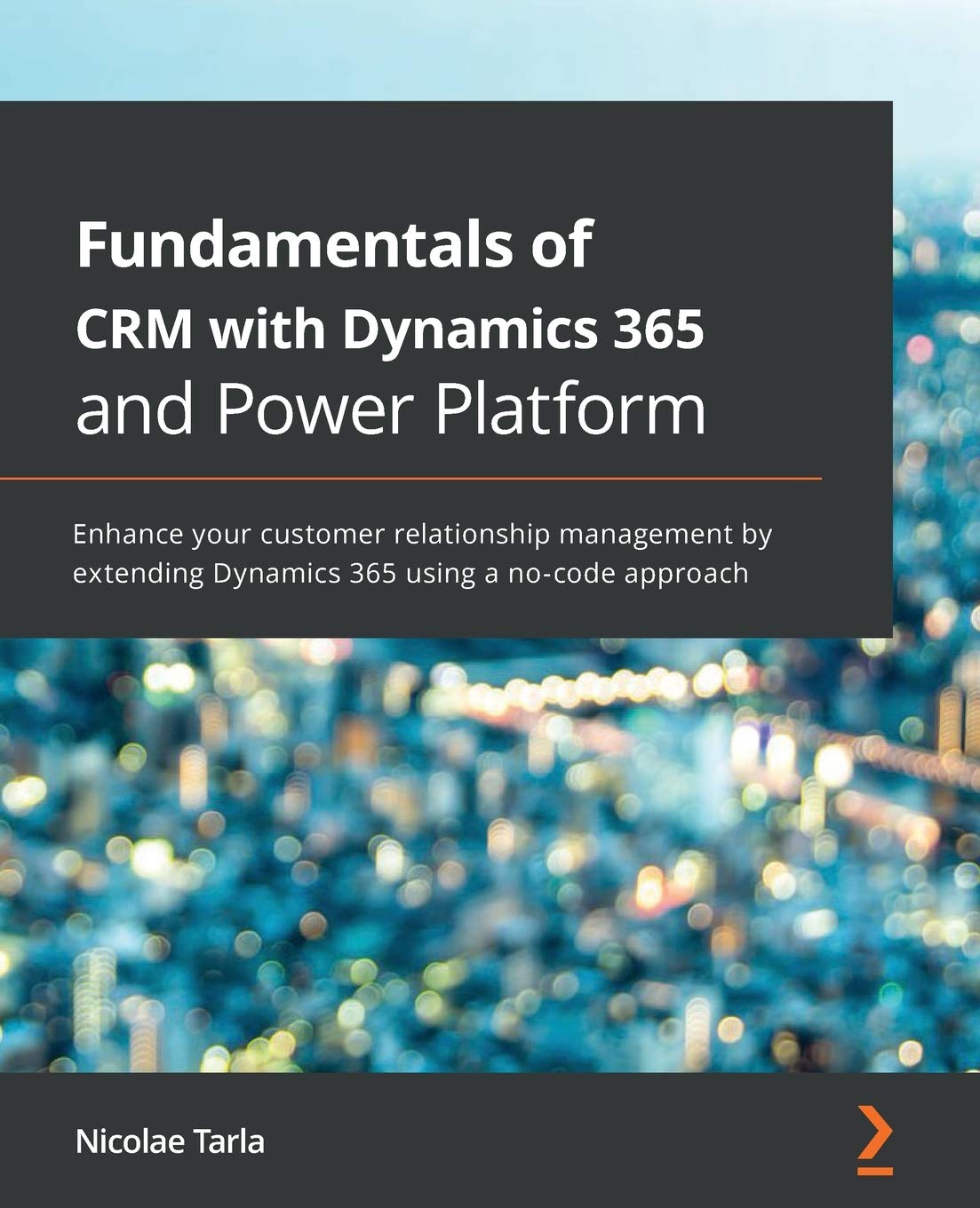


Price: [price_with_discount]
(as of [price_update_date] – Details)
[ad_1]
Explore the latest features of Dynamics 365 and Power Platform’s out-of-the-box tools to build custom business solutions for your organization
Key FeaturesDiscover impressive Dynamics 365 features to transform your business and increase productivityLeverage the platform’s extensibility to meet your organizational needsUnderstand how Power Platform powers Dynamics 365 and enhances its integration capabilitiesBook Description
Microsoft Dynamics 365 provides a vast array of tools and applications to meet various Customer Engagement requirements. This Customer Relationship Management (CRM) guide covers the latest advancements in Dynamics 365 and Power Platform that help organizations adapt to changing market conditions for agility and resilience.
With this book, you’ll explore the core platform functionality of Dynamics 365 and explore its wide range of components for transforming your business with new services and capabilities. You’ll learn the basics of configuration and customization to enhance the functionality of Microsoft Dynamics 365 CRM and create solutions and custom applications by leveraging features such as apps, portals, automation, and business intelligence. As you advance, you’ll understand how Power Platform drives Dynamics 365 and how various integration capabilities add value by providing a comprehensive view of data aggregated across different systems and data sources. Finally, you’ll delve into core administration concepts that will help you to manage extensions added to the platform.
By the end of this book, you’ll have learned how to tailor Microsoft Dynamics 365 to fit your organization’s requirements and tweak the platform to meet your business needs.
What you will learnGet to grips with Power Platform for building and enhancing Dynamics 365 appsIntegrate Dynamics 365 CRM with Microsoft 365, Azure, and other platformsDiscover how you can customize existing entities and create new onesExplore various security features and grant users access to CRM data and functionsFind out which CRM attributes are used to automate operations with programmingUse internal and external social data to help users to make informed decisionsWho this book is for
This book is for customers and project stakeholders, new functional consultants, business administration users, and project managers looking to get up and running with the latest features of Dynamics 365 and Power Platform. This guide will help non-developers become acquainted with a no-code approach to customization and configuration. A basic understanding of relational data and customer management concepts will help you get the most out of this book.
Table of ContentsGetting Started with Dynamics 365Dynamics 365 Platform StructureDynamics 365 Sales ApplicationDynamics 365 Customer ServiceDynamics 365 Field ServiceDynamics 365 Project Service AutomationDynamics 365 for marketingDynamics 365 customer engagement and the power platformCustomizing Dynamics 365Building better business functionalityOut of the box integration capabilitiesCustom integration capabilitiesCore Administration Concepts
Publisher : Packt Publishing
Publication date : 6 Oct. 2020
Language : English
Print length : 644 pages
ISBN-10 : 1789950244
ISBN-13 : 978-1789950243
Item weight : 1.09 kg
Dimensions : 19.05 x 3.71 x 23.5 cm
Best Sellers Rank: 962,961 in Books (See Top 100 in Books) 1,167 in Computer Information Systems 1,738 in E-Business 2,148 in Business & Home Software
Customer reviews: 4.6 4.6 out of 5 stars 16 ratings var dpAcrHasRegisteredArcLinkClickAction; P.when(‘A’, ‘ready’).execute(function(A) { if (dpAcrHasRegisteredArcLinkClickAction !== true) { dpAcrHasRegisteredArcLinkClickAction = true; A.declarative( ‘acrLink-click-metrics’, ‘click’, { “allowLinkDefault”: true }, function (event) { if (window.ue) { ue.count(“acrLinkClickCount”, (ue.count(“acrLinkClickCount”) || 0) + 1); } } ); } }); P.when(‘A’, ‘cf’).execute(function(A) { A.declarative(‘acrStarsLink-click-metrics’, ‘click’, { “allowLinkDefault” : true }, function(event){ if(window.ue) { ue.count(“acrStarsLinkWithPopoverClickCount”, (ue.count(“acrStarsLinkWithPopoverClickCount”) || 0) + 1); } }); });
[ad_2]
7 reviews for Fundamentals of CRM with Dynamics 365 and Power Platform: Enhance your customer relationship management by extending Dynamics 365 using a no-code approach
Add a review



Helpful and Informative
This book does exactly what it says on the tin. Provides an overview of Dynamics 365 and the Power Platform from the fundamentals up. If you are ‘technical’ but new to the Power Platform and Dynamics it will provide a useful reference book, if you are looking for a ‘Dummies Guide to Dynamics’ this is probably not the book you are looking for.This is a constantly changing environment so it will need regular updating. Sometimes though it helps too understand what constraints there were in place before upgrades and new releases are in place and so this book will never be anything less than a useful addition to your shelfDISCLAIMER: I was given this book and asked to review it.
Excellent Guide
I’ve purchased several official Microsoft and un-official Microsoft Dynamics guides over the years for training purposes. I was very impressed at the depth that this book goes into a vast variety of subject matters, and particularly how it introduces the power platform in a Dynamics centric way for those looking to upskill from older Dynamics version.The book is well written and signposts other resources well – I would recommend.
Accessible and detailed
As someone who understands and works with Microsoft 365 and the Power Platform from the perspective of Microsoft 365 but having no real knowledge of Dynamics 365 I was keen to read this book. I found it accessible yet with enough detail for me.There are some chapters I’ve not finished, but only due to finding out enough to know I won’t be using the module discussed. I found the admin chapters especially helpful with sufficient detail to understand required configuration.This book isn’t a bible, but does what it sets out to do giving the core information to get you on the road, which is after all what Fundamentals should be.The publisher approached me to provide a review and gave me a free copy of the title for this purpose, but I do think it is a book worth purchasing.
Dynamics 365 Fundamentals Must Have
A well detailed book about Dynamics 365 and would highly recommend it to anyone beginner or experienced individual. Really pleased l have this
Comprehensive introduction to Dynamics 365 and Power Platform
This book is a fundamental guide that explores the core functionality of Dynamics 365. It explains how the Power Platform is used to build and enhance Dynamics 365 apps. It covers the basics of configuration and customization to enhance the functionality of Dynamics 365 by using a no-code approach.It is a comprehensive guide, that even teaches you how to create a free trial to gain hands-on experience.I would recommend this book for new users who need to learn the suite of Dynamics 365 apps and Power Platform features.
A comprehensive, if sometimes unwieldly, guide to Dynamics 365 and the Power Platform
DISCLAIMER: The publisher approached me to provide a review and gave me a free copy of the title for this purpose. This review covers the third edition (published October 2020) of this title.When producing any content relating to Dynamics 365 and the Power Platform, the biggest challenge is the sheer breadth of capabilities on offer and the platform’s constant, evolving pace. Therefore, it makes it a real challenge for any author approaching the subject, as you have to contend with this fact and endeavour to provide correct information for any newcomers. As such, Fundamentals of CRM with Dynamics 365 and Power Platform is on a constant tightrope, and there are occasions where, regrettably and through no fault of the author alone, we start to see things fall over.The book, the first edition of which came out over six years ago, during a more “simpler” time perhaps, achieves it’s objectives reasonably well – namely, in providing detail on how to extend Dynamics 365 and the Power Platform without resorting to code. A lot of detailed information, complemented by industry experience, is provided throughout its many chapters, covering everything from core Dynamics 365 Project Service functionality to configuring server-side synchronisation. In most cases, you will obtain far more useful information than any official documentation. Nicolae does an excellent job at covering off the types of concepts or features that Microsoft Docs will leave you scratching your head at. Nicolae also does well in balancing the platform’s ever-changing nature and discussing newer, more relevant concepts. As a reference point for quickly confirming how the functionality works, the book is useful and well worth having on the shelf when the need arises.However, it’s evident that Packt and the author have provided a retrofit on the title. And here, I think, is where the most significant fault lies – there’s too much in there. As such, occasional, outdated references slip in; for example, page 9 recommends steps for setting up an Azure VM with Dynamics 365 Customer Engagement, a solution that is (arguably) not so viable or relevant in 2021, given the changes relating to the Sandbox instances. Deprecated components – such as Dialogs – are also referenced, with accurate and duly noted statements regarding their deprecation; but, in my opinion, mentioning them at all is unnecessary. Nicolae has done his very best to keep the content up to date, but the effort feels piecemeal and jarring and, even now, many of the concepts and terminology described in the book are out of date, through no fault of his own I should add. Ultimately, although Dynamics 365 and Power Platform are heavily co-dependent, it is essential to treat them as separate systems from a learning standpoint, allowing the reader to get a much more concise, relevant learning experience. The book is let down by not making this critical distinction and could have benefited from focusing solely on the core Dynamics 365 Customer Engagement apps instead.Books of this nature present the most value when they can be consistent with what the technology does, and I fully appreciate that this is easier said than done. The publisher has tried their best, alongside the author, to keep things up to date, but this is an endeavour they will fail at if updates are only released every 2-4 years, and the scope of the book remains “as-is”. Instead, breaking down the content into two separate titles would represent the best way to make the title as successful as possible, and address the issues raised above. In closing, I feel the book does represent some value to those working in the Microsoft business application space today but please only rely upon it as a quick reference tool.
I am an MCT and a trainer for Power Platform. In my courses I often notice that my participants are very interested in the topic, but often came across it by chance, for example because they want to automate processes with SharePoint lists. The possibilities of Dataverse are new to many, and this is because the relationship between Power Platform and Dynamics is not known. This book closes the gap. It introduces the basic modules of Dynamics, gives a good overview, and then moves on to Customization and Power Apps. In the meantime, I recommend this book in Power Platform trainings when participants have no Dynamics experience.have. As a basic book, I can recommend it absolutely. By the way, whether you are “forced” to rate it or not, neither the book nor the author can be held responsible for that. It is a pity when such ratings lower the average of a recommendable book. A pity and unnecessary.